Description
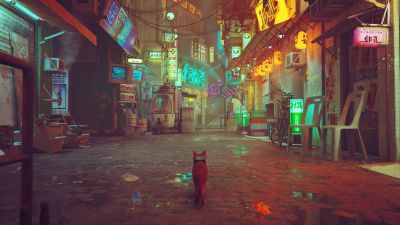
Stray is a compact exploration adventure whose convincing cat animation and densely observed robot city carry more weight than its simple puzzles. It is brief and mechanically light, but its atmosphere and environmental storytelling remain distinctive.
Stray Review
Stray places an ordinary cat in a sealed city inhabited by robots, then builds its best moments from scale and movement. Pipes become walkways, apartment windows become doors, and cluttered shops feel enormous from ground level. Contextual jumps keep traversal accessible while preserving the impression that the cat is carefully choosing each landing.
The story develops through the drone companion B-12 and memories hidden around the city. Robots give the setting warmth, but environmental details often say more than direct exposition. Scratching doors, curling up in resting places, knocking objects from shelves, and rubbing against residents are small optional actions that make the protagonist feel present rather than interchangeable.
Puzzles are straightforward, usually involving observation, carrying an item, or finding a route through connected spaces. Chase and stealth sections add pressure but offer less freedom than exploration, and occasional combat-like sequences are not the game's strength. The main journey is short, especially when collectibles are ignored.
That brevity keeps the pacing focused, though players expecting a large open world may be disappointed. Stray is most rewarding when played slowly, with attention to signs, rooms, conversations, and the city's quiet corners.
Base Info
Official Sources
LumenPlays points players to official store and publisher pages where available. Use these links to review current pricing, availability, privacy details, and device requirements.
Screenshots
How to Play Stray
Follow the contextual jump marker to move between ledges, pipes, signs, and furniture. You do not need to aim each leap manually, but you must position the cat so the intended landing point becomes available. Look upward and behind objects because routes often continue through windows, ventilation shafts, and narrow shelves.
After meeting B-12, use the drone to translate robot speech, inspect objects, store certain quest items, and provide a light. Speak with residents more than once and show relevant items to characters who may recognize them. Optional memories appear as environmental clues and add background to the city.
During pursuit sequences, change direction early and avoid being surrounded. In stealth areas, watch patrol routes and use cover rather than rushing through the center. Scratch marked surfaces when the story requires interaction, and inspect nearby props if a door or machine appears inactive.
The objective indicator can point toward the general task, but careful observation is usually more useful than moving directly toward it.
Pros
- Convincing cat movement and behavior
- Beautifully detailed robot city
- Strong environmental storytelling
- Focused pacing with little filler
Cons
- Main story is relatively short
- Puzzles are usually simple
- Chase and combat sections are less polished than exploration
Beginner Tips
- Look vertically for pipes, awnings, and windows whenever the route seems blocked.
- Talk to nearby robots and show them quest items to uncover the next useful lead.
- Explore side rooms before advancing because memories and badges are easy to miss.
- Change direction before enemies close in during chase sequences.
- Watch for contextual interaction prompts on doors, cables, baskets, and scratchable surfaces.
FAQ
Is Stray an open-world game?
No. It has several explorable hub areas connected by more linear story chapters.
Can the cat die?
Some dangerous sequences can fail, but the game restarts from a recent checkpoint.
How long is Stray?
A straightforward story run is fairly short, while searching for memories, badges, and interactions adds time.
Are the jumps difficult to control?
Jumping is contextual rather than fully manual, so route finding matters more than precise platforming inputs.
Similar Games