Description
Meowdoku combines region-based cat placement with Sudoku-style exclusion and Minesweeper-like deduction. Its friendly presentation makes the rules approachable, while larger boards demand careful marking and logical elimination rather than trial-and-error tapping.
Meowdoku: Brain Puzzle Games Review
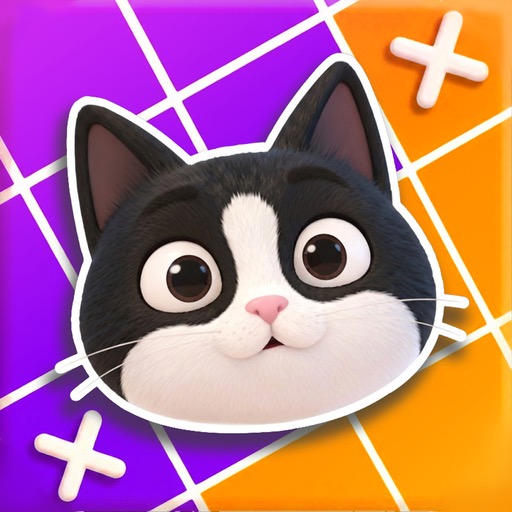
Meowdoku: Brain Puzzle Games is a logic puzzle about placing cats on a divided grid. Each row, column, and colored region must satisfy a placement rule, while cats also need enough separation from one another. The exact visual theme is playful, but the deduction resembles queen-placement and region logic puzzles more than ordinary number Sudoku.
The appeal comes from translating several restrictions into one clear decision. A cell may be impossible because its row already contains a cat, because its region is complete, or because it touches another placed cat. Marking those exclusions gradually leaves a single valid space in a row or shape.
Early boards teach one rule at a time and can be solved by scanning obvious single-cell regions. Larger puzzles require looking at pairs of rows, narrow regions, and overlapping exclusion zones. Guessing can create contradictions several moves later, so the game is most satisfying when every placement has an explicit reason.
Cats, soft colors, and gentle feedback reduce the intimidating appearance of a pure logic grid. That presentation does not make advanced levels trivial. Players who enjoy structured deduction will find a useful daily-puzzle format, while players expecting decorative cat collection may be surprised by how abstract the core remains.
Hints and error checking can help newcomers, but excessive use removes the central reasoning. Advertising or optional purchases may surround the puzzle library in the current mobile version. Meowdoku works best as a calm logic exercise, not as a scientifically validated cognitive or stress treatment.
Base Info
Official Sources
LumenPlays points players to official store and publisher pages where available. Use these links to review current pricing, availability, privacy details, and device requirements.
Screenshots
How to Play Meowdoku: Brain Puzzle Games
Read the tutorial rule shown for the current board. Place the required number of cats so each row, column, and colored region is satisfied. Cats generally cannot touch, including diagonally, so every confirmed placement excludes nearby cells as well as the rest of its row, column, and region.
Use the game's cross or empty-cell marker on spaces that cannot contain a cat. After placing one cat, immediately mark every cell eliminated by that choice. This prevents the same restriction from being reconsidered repeatedly.
Scan for a row, column, or region with only one unmarked candidate. Then look for narrow regions whose candidates all occupy the same row or column; even before the exact cat is known, those candidates can exclude cells elsewhere on that line. Avoid guessing between two plausible cells.
Move to another part of the grid and search for a deduction that resolves the pair. If a contradiction appears, undo to the first unsupported assumption rather than changing several correct marks. Use hints to learn the missing reasoning pattern, then reproduce that logic manually on the next puzzle.
Pros
- Cat artwork makes abstract logic approachable.
- Rules create clean deduction chains.
- Puzzle sizes support both quick and longer sessions.
- Cell marking helps organize complex boards.
Cons
- The theme does not add much mechanical variety.
- Guessing can create delayed contradictions.
- Hints and ads may interrupt the pure puzzle flow.
Beginner Tips
- Mark every excluded cell after placing a cat.
- Scan rows, columns, and regions separately.
- Use narrow regions to eliminate entire lines.
- Do not guess while another deduction remains available.
- Study the reason behind a hint.
FAQ
Is Meowdoku the same as number Sudoku?
No. It uses row, column, region, and adjacency restrictions to place cats rather than numbers one through nine.
Can cats touch diagonally?
The standard rule prevents neighboring placement, including diagonal contact, though players should follow the tutorial for the selected mode.
Should I guess when two cells remain?
Usually not. Another row, column, or region often provides a deduction that resolves the pair.
What are empty-cell marks for?
They record cells eliminated by existing cats or region rules, making later single candidates easier to identify.
Similar Games