Description
Portal 2 expands Valve's portal puzzles into a witty, expertly paced campaign and a separate two-player cooperative course. Its authored solutions can limit improvisation, but level design, writing, physics, and cooperative communication remain exceptional.
Portal 2 Review
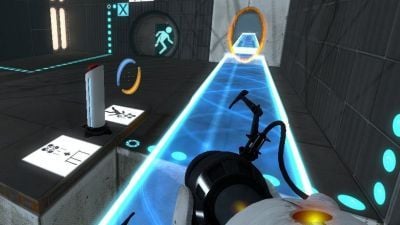
Portal 2 returns to Aperture Science, where the player uses linked blue and orange portals to redirect movement, objects, lasers, and momentum. The single-player campaign develops the facility's history while GLaDOS, Wheatley, and recorded founder Cave Johnson provide a continuous comic narrative. The portal gun keeps one simple rule: entering one portal exits the other while preserving momentum.
Valve builds new puzzles around that foundation through weighted cubes, aerial faith plates, lasers, excursion funnels, light bridges, and gels that alter speed, bounce, or portal placement. The campaign's pacing is unusually strong. Early chambers refresh basic concepts, ruined spaces reveal how tests fit inside a larger facility, and later sections combine mechanics without relying on arbitrary inventory items.
Environmental storytelling and voice performances make movement between puzzles as important as the chambers themselves. Cooperative play is a separate campaign for two robots, each controlling a pair of portals. Four active portals create solutions that require timing and explicit communication.
It is not simply the single-player story with a second character. Most chambers have a strongly intended solution, so experienced players may see less freedom than the physics initially suggest. Replay value comes more from commentary, achievements, workshop content on supported platforms, and cooperation than from radically different campaign routes.
Even with that limitation, Portal 2 remains a complete premium game whose mechanics and writing reinforce each other.
Base Info
Official Sources
LumenPlays points players to official store and publisher pages where available. Use these links to review current pricing, availability, privacy details, and device requirements.
Screenshots
How to Play Portal 2
Learn to read portal-compatible white surfaces before attempting a solution. Identify the destination, available entry surface, buttons, cube paths, and hazards before firing portals randomly. Remember that momentum is preserved.
Falling into a portal can launch the player horizontally or upward from the exit. Set both portals and check the landing area before committing to a long drop. Use cubes to hold buttons, redirect lasers, block hazards, or travel through portals.
When gels appear, trace where each stream can be redirected and which surface needs bounce, speed, or portal-cleaning properties. In cooperative play, use the ping tool and countdown rather than vague directions. Confirm which color belongs to each player, then describe the order of actions before anyone enters a dangerous portal.
When stuck, work backward from the exit. Ask what must be activated, where momentum or an object must originate, and which portal surface can connect those points. Avoid looking up the full solution until every visible mechanic has been tested.
Pros
- Puzzle mechanics are introduced and combined masterfully.
- Writing and voice performances remain memorable.
- The cooperative campaign is substantial and distinct.
- Physics make solutions satisfying to execute.
Cons
- Most chambers favor one authored solution.
- The campaign offers limited route variation.
- Co-op requires a reliable partner and communication.
Beginner Tips
- Identify usable portal surfaces first.
- Work backward from the exit mechanism.
- Plan the landing before using momentum.
- Use pings and countdowns in cooperation.
- Treat every new object as part of the chamber's vocabulary.
FAQ
Must the first Portal be played beforehand?
Portal 2 explains its mechanics, but the first game provides useful story and character context.
Does momentum carry through portals?
Yes. Speed and direction relative to the exit are central to many puzzles.
Is co-op the same as single-player?
No. It has separate characters, chambers, mechanics, and a campaign designed around four portals.
Does Portal 2 include microtransactions?
The core game is a premium campaign rather than a progression system built around paid power.
Similar Games