Description
Parking Jam 3D is a simple vehicle-order puzzle where cars must leave a crowded lot without hitting obstacles or pedestrians. Early levels are pleasantly readable, but repetition, easy stages, advertising, and side progression dilute the puzzle design.
Parking Jam 3D Review
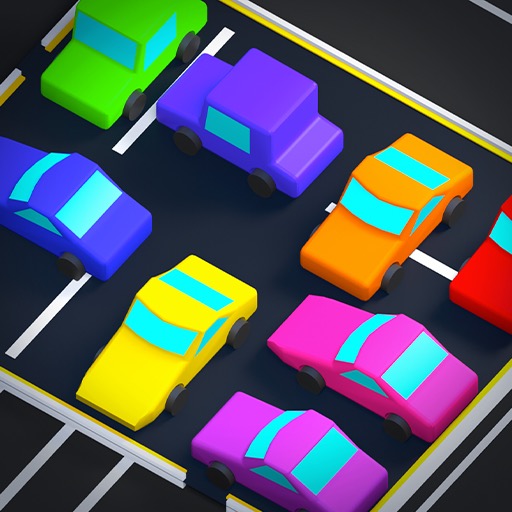
Parking Jam 3D turns a congested parking lot into a sliding-order puzzle. Each vehicle can move along its facing direction, and the player must identify a safe sequence that clears the lot without sending one car into another vehicle, a barrier, or a pedestrian. The best stages ask the player to trace dependencies.
A car near the exit may still be blocked by a sideways vehicle, which depends on another lane opening first. Because vehicles drive away after a swipe, one correct move can reveal several new options and produce a satisfying chain of departures. The approachable presentation suits short mobile sessions.
Cars are easy to distinguish, controls require little explanation, and the consequence of a move is usually visible. Boss or challenge layouts can provide larger lots and more involved sequencing. Much of the campaign is less demanding than its level count suggests.
Many boards can be solved by swiping every obviously free vehicle, and patterns repeat with cosmetic changes. Coins, property or building systems, skins, events, and reward loops add activity without necessarily improving the central puzzle. Advertising is prominent in the free experience and can take more time than a very short level.
Optional purchases and rewards should be judged against that interruption rather than treated as puzzle content. Parking Jam 3D is a competent casual sorting game for players who want low-pressure progress, but those seeking tightly authored logic challenges may find the difficulty inconsistent and the surrounding systems excessive.
Base Info
Official Sources
LumenPlays points players to official store and publisher pages where available. Use these links to review current pricing, availability, privacy details, and device requirements.
Screenshots
How to Play Parking Jam 3D
Inspect the entire parking lot before swiping. Vehicles can generally leave only forward or backward along their current orientation. Trace the path beyond each car and check for other vehicles, walls, barriers, and moving pedestrians.
Remove cars with completely clear exits first. Their departure creates space for blocked vehicles and reduces the number of possible interactions. When several cars share a lane, work backward from the one closest to the open boundary.
For crowded boards, identify the vehicle that blocks the greatest number of others. Do not move it merely because it can travel a short distance; confirm that its final path is clear and that it will not stop in another lane. Watch pedestrian timing where the level treats collisions as failure or penalty.
Wait for a safe crossing rather than swiping several cars rapidly without observing the road. Use hints only after reconstructing the dependency chain. Most standard stages do not require boosters.
Treat buildings, skins, and reward offers as optional side systems, and avoid watching an advertisement for a reward that does not help solve the current puzzle.
Pros
- Vehicle directions make the puzzle immediately readable.
- Clearing chains can feel satisfying.
- Controls and goals are accessible.
- Large challenge lots add occasional complexity.
Cons
- Many ordinary levels are very easy.
- Layouts and solutions become repetitive.
- Ads and side systems interrupt the puzzle flow.
Beginner Tips
- Scan every exit before making the first move.
- Clear fully open cars to create working space.
- Trace dependencies from the boundary inward.
- Pause for pedestrians instead of swiping blindly.
- Save hints for genuinely crowded layouts.
FAQ
What is the objective in Parking Jam 3D?
Move every vehicle out of the lot in an order that avoids obstructions and hazards.
Can cars turn inside the parking lot?
They generally move along their existing orientation rather than steering freely.
Are boosters required?
Most standard boards can be solved through sequencing without paid or rewarded boosters.
Why check pedestrians?
Some layouts include moving people whose paths can conflict with departing vehicles.
Similar Games